
Cart 0
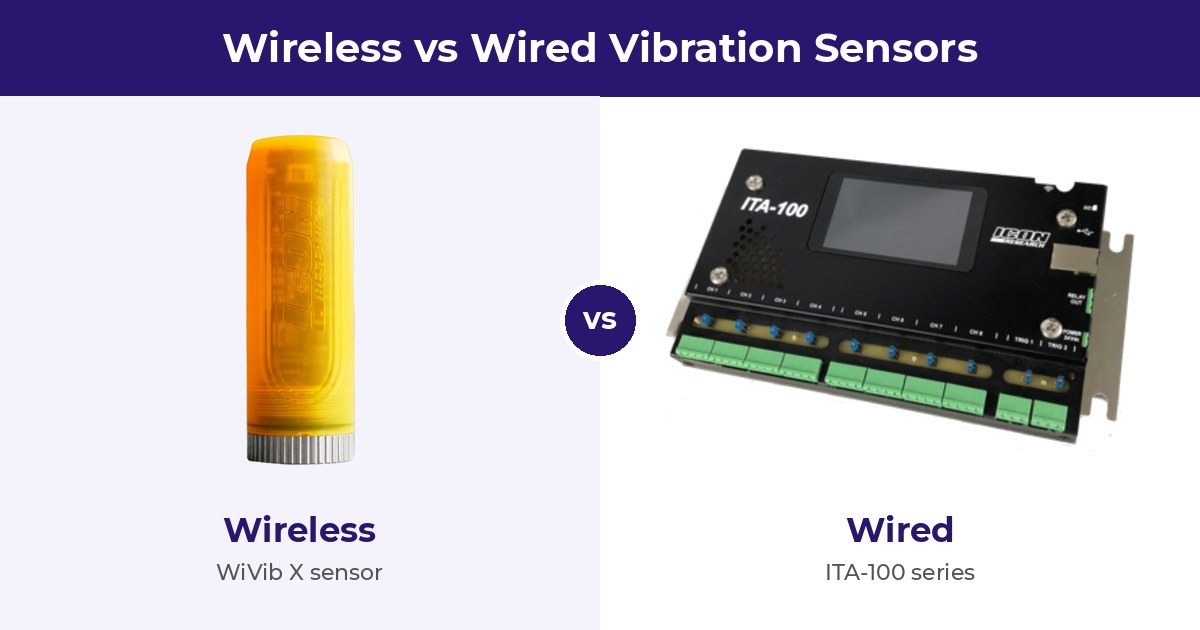

Choosing between a wireless vibration sensor and a wired monitoring system is a common question that maintenance teams ask when setting up condition monitoring. Both do the same core job, catching developing faults such as unbalance, misalignment, looseness and bearing wear before they cause an unexpected breakdown, but they suit different machines, sites and budgets. This guide explains the practical differences, where each one earns its place, and how they work together in demanding settings such as ships and power plants.
In short: wireless vibration sensors are best when fast installation, flexibility and low infrastructure cost matter, such as retrofits, remote assets, ships and awkward locations. Wired systems are best for critical, complex or high capital value machinery where high-speed surveillance or simultaneous acquisition is required. In practice most operations use a mix of both, and the two approaches complement rather than replace each other.
What is a wireless vibration sensor?
A wireless vibration sensor is a self-contained device that mounts directly on a machine and measures vibration (and usually temperature) without any signal or power cabling. It sends readings over a short-range radio link, commonly Bluetooth Low Energy (BLE), to a gateway or a handheld device.
Icon Research’s WiVib X is one example. It is a miniature triaxial sensor using modern MEMS sensing elements that measures vibration, bearing condition and temperature on rotating and reciprocating machinery. Its built-in HFE (high frequency enveloping) function gives a clear picture of bearing condition and wear, and it can track common faults such as unbalance, misalignment, looseness and early bearing wear. It works two ways. In online mode, the sensors report automatically through gateways to monitor machines continuously, 24 hours a day, with readings taken at set intervals or on demand. In walk-around mode, an engineer collects readings on a ruggedised tablet as they move through the plant on a set route, with no fixed network needed. Communication is via Bluetooth BLE for reliable, long-range performance, and the field-replaceable battery can last up to five years depending on how often data is collected.
What is a wired (cabled sensor) monitoring system?
A wired system uses accelerometers connected by cable to a central data acquisition unit. The unit digitises the signals from many sensors at once, allowing high-speed, high-resolution analysis of several machines or several points on one machine at the same time. This is the established approach for closely monitoring critical, complex or high-speed plant.
Icon Research’s ITA-100 series covers this need. The ITA-110 is a 16-channel multiplexed unit that acts as a low cost-per-channel workhorse for machinery surveillance, while the ITA-120 offers 8 simultaneous channels for high-speed, synchronised measurement and orbit analysis on complex machinery. Both accept standard IEPE accelerometers, run at 24-bit resolution with sample rates up to 102.4 kHz and bandwidth up to 40 kHz. Both include a built-in demodulator (HFE, high frequency enveloping) with programmable bandpass filtering for bearing condition, and support real-time continuous data streaming. They also handle process measurements such as temperature and pressure. They communicate over cabled Ethernet or 802.11 WiFi. An optional IP66 (Nema 4) sealed enclosure is available for harsh environments.
Wireless vs wired: a side-by-side comparison
The table below summarises the practical trade-offs. There is no single “best” option: the right choice depends on the machine, the site and how much data you need.
| Consideration | Wireless sensors | Wired (installed) systems |
|---|---|---|
| Installation | Fast. Sensor mounts in minutes, no cabling. Ideal for retrofits and hard-to-reach points. | Slower. Requires cable runs, junction boxes and mounting of a data acquisition unit. |
| Infrastructure | Minimal. No permanent power or network cabling needed at each point. | Fixed. Needs mains or DC power and a wired or wireless network to the unit. |
| Data & speed | WiVib X online mode monitors continuously 24/7 through gateways; walk-around mode is collected manually on a route. Ideal resolution for most machines. | Highest sample rates and many channels captured simultaneously, with real-time streaming and orbit analysis for complex, high-speed machines. |
| Best for | Retrofits, remote or awkward assets, ships and platforms, and the wider population of plant machines. | Critical, high-speed or complex machinery needing many simultaneous channels and the most detailed analysis. |
| Power | Self-contained battery. Up to 5 years depending on how often data is collected. | Externally powered (typically 24 V DC or mains), so no battery to manage. |
| Cost profile | Lower up-front and install cost; scales easily point by point. | Higher install cost, but strong value where many channels and continuous data are needed. |
| Icon Research product | WiVib X wireless sensor | ITA-100 series data acquisition units |
When to choose wireless
Wireless sensors make the most sense when:
- You are retrofitting monitoring to existing machines and want to avoid cable installation and downtime.
- Assets are remote, spread out, or in hard-to-reach spots where running cable is impractical.
- You are working in environments such as ships or offshore platforms, where power and network infrastructure is limited.
- You want to start small and scale up one measurement point at a time.
- Crew or maintenance staff need to collect data themselves, without specialist training.
When to choose wired
A wired system is usually the better fit when:
- The machinery is critical, complex or very high-speed, and you need the highest sample rates and detailed real-time analysis.
- You need to capture many channels simultaneously, for example for orbit analysis or complex diagnostics.
- Power and network infrastructure is already in place, so cabling is less of a burden.
- The very highest resolution and bandwidth are required for detailed analysis.
Wireless vs wired at sea
Ships are one of the most demanding environments for condition monitoring, and a good example of why the wireless-or-wired question rarely has a single answer. Space is tight, machinery is spread across decks and engine rooms, and running new cable through a vessel is disruptive and expensive.
For much of a ship’s balance-of-plant machinery, such as pumps, fans, compressors, purifiers and auxiliary motors, wireless sensors are a natural fit. They can be fitted quickly during normal operation, and because they need no specialist skills to use, the ship’s own crew can collect readings on a walk-around route rather than waiting for a shore visit. Where continuous oversight of a critical machine is needed, an online wireless setup with gateways can report automatically instead. Our related guide on wireless vibration monitoring at sea looks at this in more detail.
This crew-friendly, install-it-yourself philosophy is one Icon Research has followed for decades: our diesel engine analysis systems for ship propulsion are also designed for crew install to keep costs down. The same thinking runs through WiVib X.
Monitoring large engines and heavy rotating plant
Icon Research’s roots are in monitoring large diesel engines and heavy rotating machinery in shipping propulsion and on-shore power generation. That experience shapes how we approach vibration monitoring on this kind of plant.
On the largest, most critical machines, such as main engines, turbochargers and large generators, a permanently installed ITA-100 system captures many channels simultaneously at high sample rates, giving the detailed, real-time picture needed to watch a machine closely and diagnose complex faults. Around those critical assets sit dozens of supporting machines that were often never cabled for monitoring. This is exactly where WiVib X wireless sensors close the gap: they extend condition monitoring to the rest of the plant without a major cabling project. The result is fuller coverage, with cabled multi-channel systems where they are essential and wireless sensors everywhere else.
Why most operations use both
The wireless-or-wired decision is rarely all-or-nothing. A typical site fits wired systems on its most critical, complex or high-speed machines, where fast acquisition and the highest sample rates matter, and uses wireless sensors everywhere else: on balance-of-plant equipment, remote assets, and machines that were never cabled when the plant was built. Wireless fills the gaps without a full infrastructure overhaul.
Because Icon Research supplies both the WiVib X wireless sensor and the ITA-100 installed system, along with a variety of software trending options, we can help you match the right approach to each machine rather than forcing everything down one route.
How Icon Research can help
Icon Research has specialised in monitoring large rotating and reciprocating machinery for over 30 years, with systems exported and trusted worldwide across shipping and on-shore power generation. Whether you need a handful of wireless sensors for a retrofit, a permanently installed multi-channel system for critical plant, or a combination of the two, our team can advise on the most practical and cost-effective setup.
To discuss your machines or arrange a trial, please get in touch with our team.
Frequently asked questions
What is the difference between wired and wireless vibration monitoring?
Wired monitoring uses accelerometers cabled to a central unit that captures many channels at once at high sample rates, suited to critical, complex machines. Wireless monitoring uses self-contained battery sensors that send readings by short-range radio, making them faster to install and better suited to retrofits and hard-to-reach assets. Wireless sensors can still monitor continuously in online mode. Many operations use both together.
Are wireless vibration sensors as accurate as wired ones?
For most condition monitoring purposes, yes. Modern wireless sensors such as WiVib X provide triaxial vibration, high-resolution spectra and bearing condition via HFE. Wired systems still lead where very high bandwidth, the highest resolution, or many simultaneous channels are needed for detailed real-time analysis.
Can wireless sensors replace a wired system?
In many cases they can, particularly on retrofits and less critical machines, and WiVib X can monitor continuously in online mode. On the most critical, complex or high-speed plant, a wired system is often still preferred for its many simultaneous channels and highest sample rates. The two commonly work side by side.
How long do wireless vibration sensor batteries last?
It depends on how often data is collected, but WiVib X batteries can last up to five years. The battery is field-replaceable and the sensor reports when it needs changing.
Which industries use wireless vibration monitoring?
Icon Research’s systems are used across shipping and on-shore power generation, anywhere rotating or reciprocating machinery needs to be monitored but full cabling is impractical or costly. The same principles apply wherever critical rotating plant needs watching.

